Sunday, January 24, 2016

Public Engagement Visit 2: Polish Museum of America

This historic institution is located just up the road along Milwaukee from Intuit on Augusta off of the Kennedy, in today’s Noble Square or West Town neighborhood, the historic home of Chicago’s Polish community. I arrived a good hour early before they opened, but the lovely lady at the front desk suggested a spot down the road where I could get a nice omelet and a cup of coffee while I waited, a sweet suggestion that led me to a stroll around the neighborhood and part 1 of this blog trilogy. I happily returned after my stroll and was welcomed warmly once again.

The Polish Museum of America is a core member of the Chicago Cultural Alliance, a consortium of ethnic museums and cultural centers across the city birthed out of the Field Museum’s Cultural Connections program in the early 2000s. Although I had driven by the PMA for my whole life, growing up on the Northwest Side, it was through learning about the CCA that I was really inspired to visit, but I was still surprised by the size of the space and the awesome collection once I got inside. I was given a short, informal tour by a young history major named Adam, who had worked for the museum for about a year after graduating, as collections assistant and educator.

The museum shares the building with the Polish RomanCatholic Union of America, which was founded in the late 19th century, and sparked the museum in 1935. The museum started in one room on the second floor, but grew into its own entity on the second and third floors of the building. During the 1939 world’s fair in New York, the first in which Poland officially participated, a huge collection of artistic works were gathered in the US from across Poland, featuring a wide variety of art, from wood, to paintings, to clothing, stained glass, and folk art. When Hitler invaded Poland, they didn’t want this collection of art destroyed, so the country donated it to US Poles in the hopes that it would remain safe. The collection found its way to the newly established PMA in Chicago, and still forms the majority of the stunning collection.


The third floor was once the great hall for the Roman Catholic Union, so the bones of the auditorium space, the stage and arched windows, were still noticeable behind the layers of vitrines and artworks. The center of the room held folding chairs pointing towards the stage, where the PMA hosts much of their public programming. The PMA is the hub for Pulaski day events, holiday celebrations, film screenings, and other events throughout the year. Adam and another worker were in the middle of setting up for an upcoming caroling event by putting out a new temporary exhibit of winter themed objects around the seating area. The PMA hosts school groups and community members, individuals and families, but the small number of visitors on an average weekday visit made for a nice intimate experience with a large and impressive museum.
Highlights of the collection include photos of historic Polish Chicago, folk art, costumes, and paintings, and an art deco poster collection from the 1930s and 40s on the main 3rd floor space. There was a sled ridden by an 18th century Polish princess, who became a French queen, and a massive stained glass window that blew me away walking in. In additional rooms, one found an impressive art gallery, and the Paderewski room, dedicated to the pianist and prime minister of Poland, who spent many years in Chicago. I didn't realize how large the museum would be, so I ran out of time to fully explore these other two spaces, but I definitely want to return and bring friends, and hopefully catch a public program to see the space alive with community.

Public Engagement Visit 3: Money Museum

This is the third part in a series of museums I visited Friday for a Public Engagement in Museums class assignment to assess engagement strategies at museums. My morning visits included a trip to Intuit Gallery and the Polish Museum of America, but after going to work for a few hours I had extra time, so I decided to check out some architecture downtown. My dad had recently suggested I visit the old Continental Bank atrium, which has beautiful murals wrapped around the epic bank space on the second floor. They're a little weird about security, so people aren't allowed to just walk around the whole room, but you can see plenty from the escalator entryway, and it's definitely worth a visit!

It turned out security would be a theme for my afternoon on Lasalle street. I was leaving Continental bank and remembered the Federal Reserve hosts a small Money Museum across the street at Lasalle and Jackson, by the Board of Trade. I hadn't planned to visit this museum when I packed ahead for the day, so I wasn't prepared for the metal detector and security check. I'd brought a knife to cut my avocado for lunch! So that was left in a safe at the front desk along with my water bottle, and I was allowed to proceed unhindered. The security guard was at least very nice, with a much more laid back and cheery disposition than those you'd find at the airport.

There was an immediate difference between this museum and the other two I'd visited that day: Money. It should come as no surprise, perhaps, but the quality and caliber of exhibit and display technology far surpassed that which is usually in the budget of your average non-profit organization. Everything was sparkly, new, and clean in this 15-year-old museum. Exhibits also also gave the sense of security in their fixtures, with heavy bolts, thick tempered glass, and plentiful lighting. There was a glass floor in the entryway where you could look down and see a sea of coins. When you stepped on the glass, rainbow track lighting lit up the sunken floor and made for quite an entrance.

The exhibit content was similar to what you'd expect in some ways, there were labels that told stories about how the Fed was founded, what the Fed does for the American economy, and how money is made and destroyed. One awesome feature of the museum was the top-notch collection of antique currency. They had confederate money, revolutionary-era money, state-specific currency from before the establishment of the fed, and military currency used to pay our armed forces posted overseas in the early 20th century. Most museums would have a hell of a time getting hold of rare currency like that, but of course, the fed exists to deal with the nation's old money.

Another surprising feature was the plentiful digital technology. For comparison, the Chicago History Museum has an awesome interactive exhibit on their first floor that lets kids take their picture in a postcard, use a digital touch screen to add their name, and email it to themselves as a souvenir. There were three such stations at the Money Museum. In one spot you could take a picture of yourself next to a suitcase of money, and the photo printed out right there. In another spot you could make your own currency, adding in a photo of yourself, decorative designs, and all the proper security features, then email it to yourself. In a third area you could take a quiz game, utilizing the information recently absorbed from exhibit labels, to decide what the fed would do in various national economic situations. Once you've successfully completed the game, you took a photo and could have your face printed on a newspaper article or magazine cover as the next head of the Fed! Each station featured two computers for multiple visitors to engage at once.

There were also touch screen stations where you could find out info about the Fed, about common banking options, and the types of money the Fed shreds. At that table visitors could take away their own to-go bag of shredded money! My phone was dead by this time so I couldn't take my own pictures, but I certainly walked away with plenty of souvenirs nonetheless. There was also a traditional form of visitor engagement in the form of a feedback table, where you could fill out a card and drop it in a box, and take a postcard to send to your friends and family about your visit. A theater sat near the right of the entrance at the end of the exhibit, which could probably seat a whole classroom easily, so one could assume they have plenty of school visitors.

The Money Museum isn't rooted in a specific local ethnic community like the Polish Museum, it doesn't house a study or performance space like Intuit Gallery, but it is something we all have a certain connection to. There has always been a portion of society that has been suspicious of the Federal Reserve Bank, of centralized monetary systems, and the policies they use to alter our economy. But especially recently it seems like we've heard increased rhetoric of that sort, so perhaps museums like this one were created by the various Federal banks across the country to help educate and assuage the public about the role and benefits of such a system. Some might find financial policy boring, some might find it controversial, but they certainly work to make it seem engaging and rewarding at the Money Museum of Chicago.

Public Engagement Visit 1: Intuit Gallery

For my Public Engagement class this semester we were assigned to visit a museum, think about how the exhibits are engaging, and talk to another visitor about their engagement. I spent a Friday morning and afternoon visiting three small museums. Since it was a weekday, and wasn't a holiday, I didn't find other visitors, but I was able to engage with a neat variety of exhibits, and talk with workers at each place. I planned to visit the Polish Museum of America first, but arrived too early, so I went for a walk, grabbed a cup of coffee, and visited the beautiful St. John Cantius Cathedral on Chicago and Ogden, which has beautiful woodwork (photos to the right). I found myself right by the Intuit center, so I started there instead.

Intuit Center for Intuitive and Outsider Art
Located near the Chicago Blue line stop, Intuit is accessible, but unassuming from the outside. There's a large sign, but the warehouse look of the building and windowless walls and door give a secretive feel to the place. However, once I was inside, I was quickly greeted by a welcoming employee and guided into the gift shop to pay my $5 entrance fee. He asked how I had heard of the place, gave me the lay of the land, and provided a little info about the exhibits. I grabbed a few pamphlets and a sizable printout about the new exhibit and started exploring.
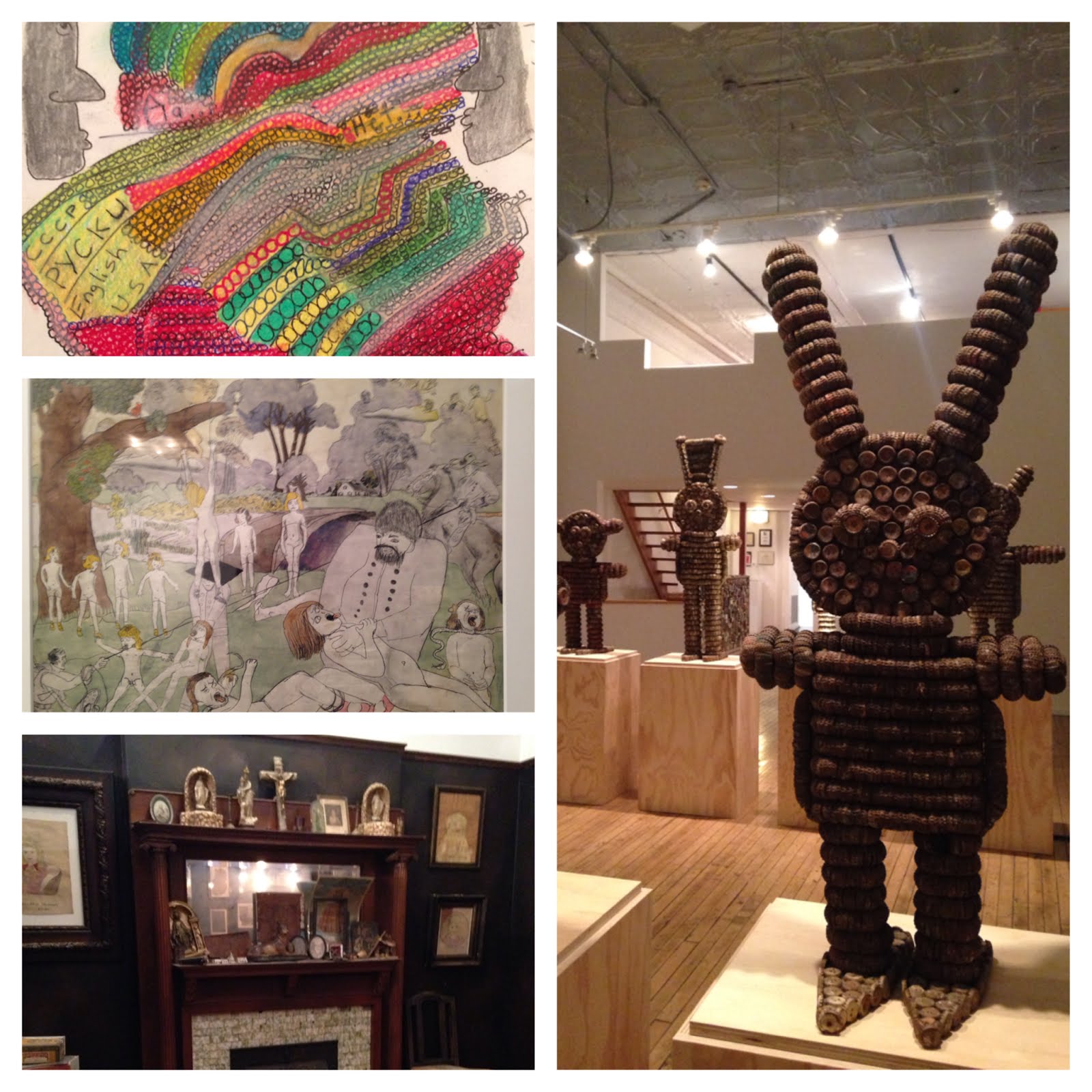
The new Caparena exhibit features sculptures that look like a cross between human, alien, or animal, made entirely of bottle caps and wire. The metallic look was tempered by the way they were layered to appear fluffy and rounded from a distance. They were on rows of pedestals at waist height, making them quite tall, with a few glowing lights under a couple of them. They were cool, but there wasn't much to engage with. In the back room, the walls featured a few more art pieces, some large and some small, a couple of them by the artist Henry Darger, and in the center of the room was a large bench, always a nice feature. In the back, a small exhibit featured the whole cramped one-room apartment of Darger, an acclaimed outsider artist with a passion for his work so strong that he sacrificed even a bed to make room for creative materials. This exhibit was definitely immersive, and weird, but let me wanting to see more of Darger's actual work, to see how the space influenced the art.

I will commend them for their large event space through a side door next door, their cute and nifty gift shop, their ample seating, and awesome bathroom. The bathroom was large, covered in wall art and artsy furniture, had two homey stalls, flowers, and nicely folded paper towels on the counter. I don't often review a museum's bathroom, but this one stood out and certainly influenced my sense of engagement with the space. Although the museum’s entryway and weird art may not appeal to all tastes, Intuit certainly makes the effort to make visitors feel comfortable and welcome in other ways. It seems like they do a lot of public programming, and often feature new exhibits, so I'll have to return and see the vibe and community of the space on a different day.

Thursday, November 6, 2014

Interview with Union Organizer Thomas Haley

image
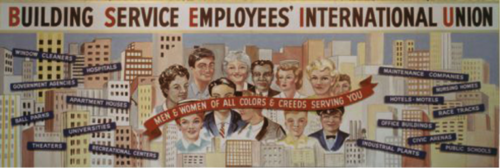
Founded in 1920 as a Janitors Union of only 200, the Service Employees International Union has grown to 2.2 million members in the United States, Canada, and Puerto Rico. Illinois local 73 has over 28,000 members, ranging from the Chicago-land area and northwest Indiana, down to Cairo. Thomas Haley has been involved with the Service Employees International Union for seven years. Beginning as a worker himself, he became a full-time union organizer three years ago. With local 73, he’s helping to empower people every day. 

Lena Reynolds: What kind of workers do you work with?

Thomas Haley: I’m an external organizer, for people outside without unions. They call us. We have three locals in Illinois: HCII is healthcare, local 1 is for the private property services, and we’re local 73, for the public property service workers. It’s a broad range. We represent members in the cook county justice system, like detention aides. We have crossing guards for school kids that work with the Chicago Police Department. It includes the guards downtown at Millennium Park. We have people in CPS, like bus aides, bus monitors, custodians, service workers… It includes the Urbana park districts and the University of Illinois in Urbana-Champaign, which is actually where I got my start.

LR: What drew you into labor organizing?

TH: I got hired at the U of I as a custodian. I didn’t even know it was a union job until a 70 year old guy comes up to me when I was working nights. At like three in the morning, he slaps a card down on the table and says, “sign this.” I said, “what is it?” “Your union card!” Well I was an inactive member until I had some problems with management. I had a foreman who was messing with me, and I didn’t really know how to deal with it. And I was lucky, because I did some things that probably could have gotten me disciplined, you know, being a smart aleck, insubordination… But nothing happened, and so I contacted a steward for the union in our shop. “How can I get involved? How do I learn to protect myself from situations like that?”
image

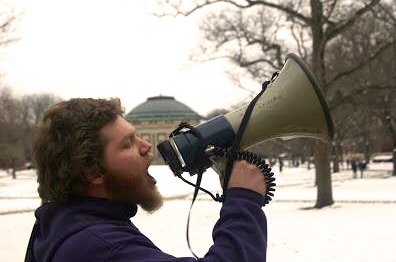
He got me involved with our local. I became a steward, then a board member, then a bargaining team member. Management was pushing a really hard deal on us, so we went on strike in March of 2013. It went on for three days and had a 97% participation rate out of about 800 workers. We had only 12 verified scabs (person who goes to work during a strike).

LR: Wow!

TH: Yeah! Trash was piling up all over campus. They ended up putting big trash bins in the hallways and they were all overflowing by the time we got back because there was no one to empty them. Foremen were trying their best, but you can’t replace 800 workers with like 5 people. We voted to go on strike after about 9 months of bargaining and really getting nowhere from management. A strike is a very powerful tool in the members’ tool chest, you know. Nothing takes the boss out of business like taking your labor out of the shop. So that thrust me into a light of recognition. I did a lot of interviews with papers in the area. I was on a national radio show, and I got noticed by local 73 in Chicago. They asked me to come up to become an organizer.

LR: So what does a day look like for you?

TH: I asked my friend that before I got hired, and she said, “there is no normal day.” I’m on call 24 hours a day, 7 days a week for potential members. Whenever they want, I will meet them. On “normal” days we’ll come into the office to research things and do the support work for our active campaigns. That’s the boring side, but split that with being out in the field, I’m talking to people about forming their union.

In my job, you’re either crawling or sprinting. In campaign mode, it’s 13-14 hour days, everyday until the election, so the workers stay informed. (When workers vote to unionize) It’s not just like you file, you get an election, and you win. The boss does everything in their power to stop you from having a union. They’ll hire expensive lawyers, they’ll lie, they’ll intimidate. The power structure puts them up high and workers down low, but with a union, they’re equals. They can’t unilaterally change things in the workplace without consulting with the workers. In Illinois, without a union contract, you’re an at-will employee. You can be hired and fired at management’s whim. You have absolutely no recourse about it, no protections.

LR: The face of labor has changed over the last generation, how has SEIU changed with the times?

TH: Our organization changed THE times. We were the first international union to put a large portion of the budget into organizing. We’re the fastest growing service employees union in the world with over 2.2 million members worldwide.

There’s a lot of misinformation about what a union is. The message has been so skewed they just think of overpaid, lazy workers. That’s where I think labor has dropped the ball, because the messaging hasn’t been there. The right wing has been telling everyone how bad unions are and unions are just looking inward, maintaining their groups, instead of looking out. And that’s great to work for your members, but not everybody has that chance.
image
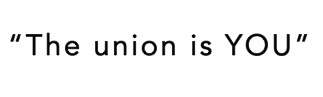
 We’ll ask the worker, “do you know what a union is? What is a union to you?” and they’ll say, “it’s a group that comes in and helps us.” And I say, “No, the union is YOU. Your union is only going to be as strong as YOU guys.” Our job is to go in there to encourage and empower them. Because most the time if they’ve called us, they’re at that point in their career where they’re like “what’s the worst that’s gonna happen, I’m miserable already. I could lose my job any day anyway.” A boss could fire you tomorrow if they don’t like your haircut.

But there’s people speaking out again now, starting to point to how the economy worked when like 30-40% of the country was unionized. The higher that number, the higher the median income. Now you see more people (the majority) working for minimum wage. You see union density at 6% and dropping, and the difference between the haves and the have-nots growing.

LR: What are some other initiatives going on?

TH: Our international has also been involved with the Fight for 15 campaign. It started off with fast food workers trying to make a living wage. People say they don’t deserve $15, but if minimum wage had kept up with inflation since the ‘60s it would be around $21. There are fast food places on every block. So many people are needed to staff these places that it’s not just the high school kid anymore, because there aren’t enough of them. It’s becoming more middle aged people with families, and people with college degrees that can’t find jobs. Wage theft is rampant; wages are garbage.

Our international took an early role in getting involved, and now it’s grown. We’ve started the nation-wide conversation about minimum wage. Cities are raising to $10/$12 and Seattle and San Jose have reached $15/hr. These companies are making billions, while their workers are forced to live on subsidies from the government. So we’re collaborating, and it’s not just the workers, it’s their families, their clergy, their community members… People realize that if they make more, they’ll bring that back into the community, which can support itself. It’s not just the rich hoarding everything. That’s why SEIU is so awesome, it’s social change, not just labor change.
image
LR: I think that’s a great example of how the shift of workers has changed over the last generation, so the shift of labor and our consciousness about it needs to change too.

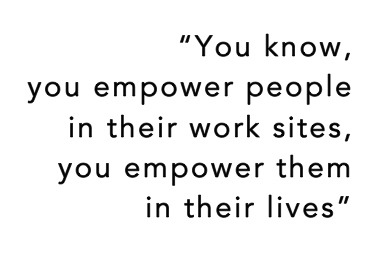
TH: Yeah, they say history repeats itself. At one point the mine workers were helping the auto workers. The auto workers helped the electricians build their union. Nowadays you see the service workers helping the fast food workers build their union. It’s not just $15. They want $15 and the right to unionize without fear of retaliation. SEIU knows they’re not going to be organizing with us, but they will have the ability to build the labor movement as a whole. You know, you empower people in their work sites, you empower them in their lives, you take that out into the world. My whole job is to empower somebody to do what they want to do. If you can’t tell I love my job!

LR: Do you think you’re going to do this forever?

TH: Not as an organizer, but I’m going to be involved with the labor movement in some way. People seem to really like me being around, so maybe I’ll run for election someday. That’s another thing we face. It’s OUR turn to start building the labor movement. It’s about informing our generation.

LR: Hopefully this interview will inform my classmates of our generation.

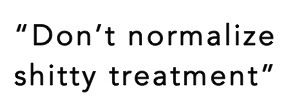
TH: Let them know, they should vote, but most importantly, don’t normalize shitty treatment. If you’re getting treated poorly on the job, recognize that, stand up against it. There are avenues for you to take. If I had a dollar for every time I’ve heard of someone who got crapped on at work, who just normalized it. I’ve talked to workers who just go home and cry because they can’t do something for their family. They sacrifice, making choice on food or medicine or rent. You don’t have to just take it. The message has led everyone to believe “well its just the way it is.” No. Speak up and you strengthen everyone around you.
image

Saturday, November 1, 2014

Ode to a small museum: Maison de Victor Hugo - Paris

image

Before I left for a semester in Paris, I read Victor Hugo’s Les Miserables in its entirety. I was blown away by the powerful story: suspense, drama, and such insight into the human condition. After gaining an intimate connection with his work, I visited Hugo’s home and felt it was unlike any house museum I’d ever visited. Too many house museums depict history in a detached sense, as a place where some wealthy statesman retreated from the world and his work. Historic homes for artists and writers, however, are usually known as sites of work and action, a place where magic happens.

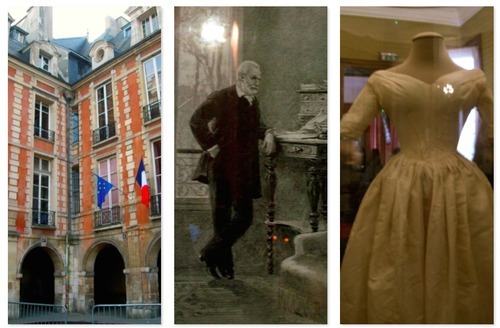
Victor Hugo (1802-1885) was a prominent French author who helped to define the romantic era novel. His works have been famously reinterpreted in film, architecture, and broadway musicals, and two of his homes are now museums. Hugo’s Paris home is the glorious Place Des Vosges, a beautifully symmetrical square of seventeenth century apartments encircling a park. When he lived here, Hugo looked out over a piece of Paris that was far removed from the poverty depicted in Les Miserables. His life never held the financial hardship his fiction depicts, but he did experience his share of turmoil.

Hugo was forced to leave this palatial home halfway through his career. Because of his politically radical views, Hugo was once deemed a danger to the nation and was banished from France. His staunch republicanism became quite controversial after the rise of a new emperor in the 1850s. Once Napoleon III was forced from power in 1870, Hugo returned a hero. Although he didn’t live in this house consistently, the home includes artifacts from throughout his life.

The simple entryway’s walls of white marble are decorated with paintings of Hugo’s youth and his family. In the center of the room hangs a young woman’s dress. It’s wall label describes one of Hugo’s most heartbreaking experiences. In 1843, his eldest daughter Leopoldine drowned in the Seine when she was only 19. Hugo wrote many early poems about this tragedy, and undoubtedly drew on the experience throughout his career.

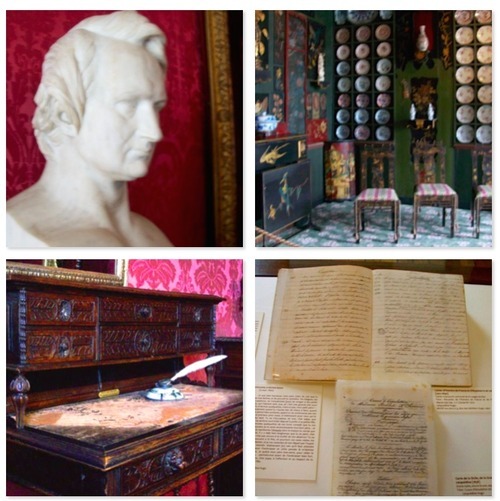
Unlike the white of the first room, the next space is robed in red velvet, from the tactile wallpaper to the voluptuous curtains. As Hugo’s career took off, his decor seems to have become more elaborate. In the early years, he supported the monarchy, and the baroque furniture here seems drawn straight from King Louis Philippe’s sitting room. Hugo welcomed artists like Dumas, Lamartine, and Gautier to salon conversations in this room. Some of his more radical guests would eventually persuade his political views and his shift away from supporting the king to republican nationalism.

The dark gothic style of the next two rooms symbolizes this shift, with heavy wooden furniture around a medieval dining room table, split-paned glass windows, and an ornate four-poster bed amid ancient tapestries. It is here that visitors remember Hugo’s role in reviving artistic appreciation for gothic art. Through his famous novel, Notre Dame de Paris (The Hunchback of Notre Dame), Parisians saw their crumbling architecture through new eyes, for Hugo’s main character was the Notre Dame cathedral itself. Shortly after publication, Parisians rallied to renovate the iconic flying buttresses, gargoyles, and stained glass windows, which today comprise one of the most visited places in the world.

image

One sitting room really stood out for me. It is decorated entirely in Asian art: carved wood, delicate china, and gilt paintings. In Hugo’s time, as globalization and European empires brought art from the other side of the world, the exotic style became quite fashionable. In the face of these global “others” European artists were inspired to look inward and explore their own local culture, like Hugo’s interest in Parisian medieval art. Nationalism was both a political and an artistic theme in the Romantic era: Hugo’s Asian room portrays a fascinating foil to his francophone literary voice.

One of the most powerful pieces on display is not immediately evident. Indeed, many visitors often walk right past it. Next to a window, standing chest-high, is the artifact Hugo used the most: his writing desk. He preferred to stand while he wrote, an odd quirk that somehow makes his writing process more visceral. Visitors can see early drafts of his writing and desk’s rough surface and imagine themselves standing there in the place of Hugo himself. The magic of the artist’s home comes from seeing the humanity behind the brilliance, a reminder that any one of us is capable of creating something extraordinary.

Thursday, October 30, 2014

To conform or not to conform: Magritte's question

image

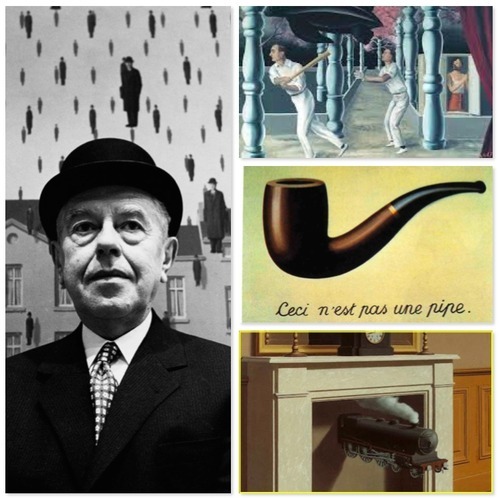
In our world of rules, the art of RenĂ© Magritte questions everything: love and language, right and wrong, and the nature of truth and illusion. Magritte: The Mystery of the Ordinary, 1926-1938 at the Art Institute of Chicago is on display from June 24 to October 13, 2014. Although Magritte’s work asks us to question conformity, the art itself is posed in stark contrast to the realities of crowd control in a large public museum. The restricted exhibition layout and overzealous security guards impose an institutional authority that expects visitors to follow museum standards even as the art rejects such expectations.

Magritte’s fame is immediately visible as I approach the gallery - the line goes out the door. Only small groups are allowed to enter at a time, in order to keep the crowds manageable. After a 15-minute wait, I enter with my group. Someone near the front notices the introductory wall label, inspiring the whole group to stop and read. Magritte, we read, wanted to “overthrow the oppressive rationalism of bourgeois society,” and yet here we are, ironically corralled into mimicking a herd of strangers.

The first several rooms are tight for the sizable crowd. The works in these rooms evince some of the artistic symbols Magritte was most fond of: bilboquets, bowler hats, and clouds. In one painting, two men are playing baseball, but oddly, they’re looking off in the same direction. I think about the arbitrary nature of sports rules: if we try it facing the other way, is it still baseball? As I wonder, a security guard approaches the woman next to me and tells her she must wear her backpack over her chest. Although my first thought was that perhaps a passionate curator wanted to give visitors a physical sense of backwardness to match the painting, I soon decide it’s probably meant to deter theft and facilitate crowd movement.

We wind along in a line, sometimes into tight corners with little space fo th double row of traffic. One hallway has two of the exhibit’s most disconcerting paintings. In the left painting is a girl biting into a bird, which was inspired by Magritte’s memory of his girlfriend eating candy. The painting on the right was inspired by repetitive wallpaper design, and here rows of half-masticated birds continue the themes of the previous painting. Visitors who are stuck next to these pieces look visibly disturbed, but traffic is caught, waiting to enter the cramped room that follows. I can’t help but wonder if this was unfortunate exhibit design, or a conscious effort on the curators’ part to upset the bourgeois visitor by forcing us to confront our own carnivorous human nature.

In the second section’s works, we see Magritte starting to play with language. A few paintings seem like simple word-association tests at first, until viewers read closer. “Sky” is written below an image of a briefcase, “table” below a leaf, and “sponge” below a sponge. An excellent wall label makes sense of this nonsense: “Magritte reminds visitors of the arbitrariness of language and meaning. Even in the case where the word and image are the same, neither of course is a real sponge.” This theme leads to one of his most famous pieces, The Treachery of Imagery. The words across the bottom, “Ceci n’est pas une pipe” remind us that the image above is not a real pipe at all, but only a painting of a pipe.

Looking to a following room, I see a crowded bench and realize how little seating I’ve seen throughout this exhibit. Visitors are not invited to take time and ponder, but encouraged to keep moving, like an assembly line for art appreciation. I wonder what Magritte would have thought. Fortunately, the later rooms of the exhibit are significantly more spacious than the first rooms. A long hall hung paintings on the same side of 12 walls, standing in a row down the middle, like a line of dominoes. Each painting finally had sufficient space for viewing, and ample room for passing by on either side.

The last painting on display is called Time Transfixed. This large painting depicts a fireplace from a seemingly ordinary room. A mirror and a clock hang over the mantlepiece, but coming out of the hearth is a train. As a woman next to me leans close to read the label, a security guard in the corner coughs loudly. The woman turns and he shakes his head emphatically, reminding her not to get too close, to follow museum etiquette. I’d almost gotten lost in the art again, but museum regulation brought me back to the real world. Looking at the clock on the mantle, I’m reminded to check my own watch before leaving, in order to catch the next train on time. Maybe next time I’ll overthrow rationalism.

Depaul Art Museum - Short Review


The Depaul Art Museum’s shiny new building beckons to El riders passing through Lincoln Park. It’s so close to the Fullerton stop you can practically see into the second floor window from the platform. Just beyond that window, Ink Paper Politics: WPA-Era Printmaking from the Needles Collection is on display at the DPAM through December 21. The new show exhibits prints produced by a variety of artists funded by the federal Works Progress Administration in the midst of the 1930s-era Great Depression. Collective workspaces and federal funding united artists from diverse ethnic and racial communities, creating a historic moment that spurred innovative printmaking. Over 100 pieces grace the walls with images of work and play, home and factory. Trains are a common theme, representing Depression poverty through urban hustle and rural transience.

Martin Lewis’s Passing freight depicts a night train racing past a sleepy country home, playing with shadow and light in excellent clarity. The busy print of Millard Owen Sheet’s Family Flats, 1935 layers people over one another’s homes in a cosmopolitan tenement setting. It depicts laundry lines and back-porch stairways criss-crossing the scene in angles, exuding movement and life. Some pieces focus on personal stories: a tap dancer seems to burst off the edges of the print, a preacher clutches a large bag of money in his fist, and two men tousle on a dock - a violent scene expressed with surprising lyricism as they spiral into one another’s bodies. One of my favorites, Autumn in Mill Street, 1940 by Harold Maxwell Hahn, depicts a simple country road on a fall day, but the precise detail and rich colors are conveyed with phenomenal skill. This piece stands out as a rare moment of serenity in an otherwise fast-paced exhibit. The recurring train themes remind visitors of the bustling transportation just outside the gallery, and the economic themes provide a more cutting reminder to our own recession concerns. The DPAM is accessible and affordable, and the timely art is well worth a ride on the rails.

image